How do AI-native coding assessments compare with traditional coding tests for technical hiring?
Your engineers ship code with AI every day. Then your hiring process asks candidates to reverse a linked list from memory, with AI banned, in 45 minutes. The test is measuring a job that no longer exists. AI-native coding assessments flip that. Candidates get an AI assistant inside the test, and the platform scores how well they use it. Here's how the two approaches compare, where each still makes sense, and how to combine them.
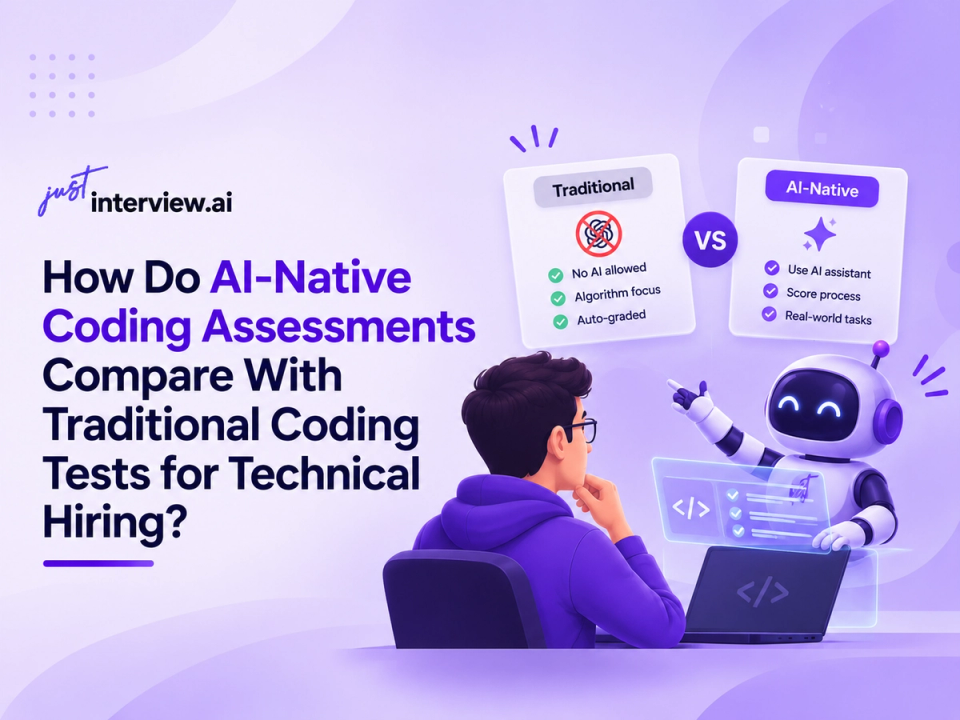
A side-by-side comparison of traditional coding tests and AI-native coding assessments: what each measures, where each breaks, and a hybrid funnel that uses both.
Traditional coding tests were built for a different job
The classic coding test is a timed algorithm problem, solved without AI and auto-graded against hidden test cases. It measures recall, speed and syntax. That made sense when engineers wrote most code by hand.
It doesn't match how engineers work now. In a March 2026 CodeSignal survey of 450 US software engineers, 91% said they use agentic AI coding tools, and 75% had shipped production code that was partly or mostly AI-generated in the previous six months. Karat's survey of engineering leaders found 71% say AI is making technical skills harder to assess, yet 62% of organisations still prohibit AI in technical interviews.
What an AI-native coding assessment is
An AI-native coding assessment builds an AI assistant into the test itself. Candidates work on a realistic task, use AI the way they would on the job, and the platform records every prompt. Scoring covers the final code and the process: how the candidate framed the problem, whether they checked the AI's output, and how they fixed what it got wrong.
The category is moving fast. Codility designs some tasks so the assistant's most common suggestion is wrong, rewarding candidates who catch it. CodeSignal launched agentic assessments in April 2026 using tools like Claude Code, Cursor and Codex. HackerRank offers AI-assisted tests with guarded and unguarded assistant modes. JustInterview.ai's Vibe AI logs and categorises every prompt.
AI-native vs traditional coding tests, side by side
| Dimension | Traditional coding test | AI-native coding assessment |
|---|---|---|
| What it measures | Algorithm recall, speed, syntax | Problem framing, judgement, verifying AI output, code quality |
| AI policy | Banned, but hard to enforce | Allowed, built in and logged |
| Cheating risk | High: hidden AI use inflates scores | Lower: AI use is visible and scored |
| Job realism | Low | High |
| Scoring | Pass or fail on test cases | Correctness, code quality and reasoning |
| Candidate experience | Familiar, but puzzle prep and stress | Closer to day-to-day work |
| Best for | Fundamentals and high-volume entry-level screening | Most product and software engineering roles |
Where traditional coding tests still win
- Fundamentals screening. For campus and fresher hiring, a no-AI test shows whether someone understands loops, data structures and complexity.
- Roles where AI isn't permitted. Some security, defence and regulated environments restrict AI tools on the job, so the test should too.
- Very high volume. Standard tests are simple to compare across thousands of candidates.
Where AI-native assessments win
- Real signal. You see how someone will actually work in your codebase, not how well they memorised patterns.
- Harder to fake. When AI is allowed and logged, there's nothing to hide. Blind copying shows up as overreliance in the prompt log.
- Better seniority signal. Juniors tend to accept the first answer. Strong engineers question it, test it and fix it.
- Better candidate experience. Candidates work the way they're used to working, which reduces puzzle-prep fatigue.
Watch-outs with AI-native assessments
- Scoring the process is harder. Ask vendors exactly how reasoning quality is scored and how consistent it is between candidates.
- Tool familiarity. Give candidates a short warm-up so they aren't learning the assistant during the timed task.
- Fewer benchmarks. The format is newer, so calibrate it by running your own engineers through it first.
How to combine both in one funnel
- Screen fundamentals at volume with an MCQ or a short Standard Code test, AI off.
- Assess shortlisted candidates with an AI-native task that mirrors the role.
- Verify with a conversation about the candidate's own submission, live or through an AI interview.
JustInterview.ai supports this in one platform: Standard Code and MCQ for screening, Vibe AI for realistic tasks, and AI interviews for the follow-up, all in the same report format.
What changes for engineering managers
Interview loops stop arguing about whether a candidate secretly used AI and start discussing how well they used it. That's the conversation that predicts on-the-job performance. Strong engineers who'd fail a memory test get through, and candidates who can only paste prompts get filtered out earlier.
Frequently asked questions
Isn't an AI-native assessment just letting candidates cheat?
No. Cheating means hiding help. In an AI-native assessment, AI use is allowed, visible and scored. A candidate who blindly copies output scores poorly on reasoning and gets flagged for overreliance.
Do traditional coding tests still have a place?
Yes. They work well for fundamentals screening, campus hiring at volume and roles where AI tools aren't allowed on the job. Many teams use them as a first filter before an AI-native task.
What skills does an AI-native coding assessment measure?
Problem framing, breaking work into steps, prompting clearly, verifying AI output with tests, catching and fixing errors, and code quality. It still checks correctness against test cases.
Are AI-native assessments harder for candidates?
Different, not harder. Most candidates find them closer to real work. The main adjustment is learning the built-in assistant, so a short warm-up question helps.
Key takeaways
- Traditional coding tests measure recall and speed with AI banned, which no longer matches how engineers work.
- AI-native assessments build AI into the test and score how candidates frame, verify and fix AI output.
- Traditional tests still suit fundamentals screening, high volume and roles where AI isn't allowed.
- A hybrid funnel works best: no-AI screen, AI-native task, then a conversation about the candidate's own code.
Based on JIA internal platform data across 5,000+ candidates.
Get started
Test how engineers actually work in 2026.
Run Standard Code and Vibe AI assessments side by side in JustInterview.ai, with every prompt logged and scored. Try it free for 14 days, no card needed.