Should engineers be allowed to use AI in your interview?
Imagine two candidates applying for the same engineering role. One writes the solution entirely on their own. The other uses an AI coding assistant, questions its suggestions, fixes its mistakes and arrives at a working solution. Both solve the problem. Which one would you hire? That question sits behind the vibe coding interview, a format where candidates can use AI during the task. As AI becomes part of everyday development, the old ways of evaluating engineers deserve a second look, and your interview platform needs to keep up.
Engineering interviews are changing. A closer look at what technical hiring should measure when AI is part of the job.
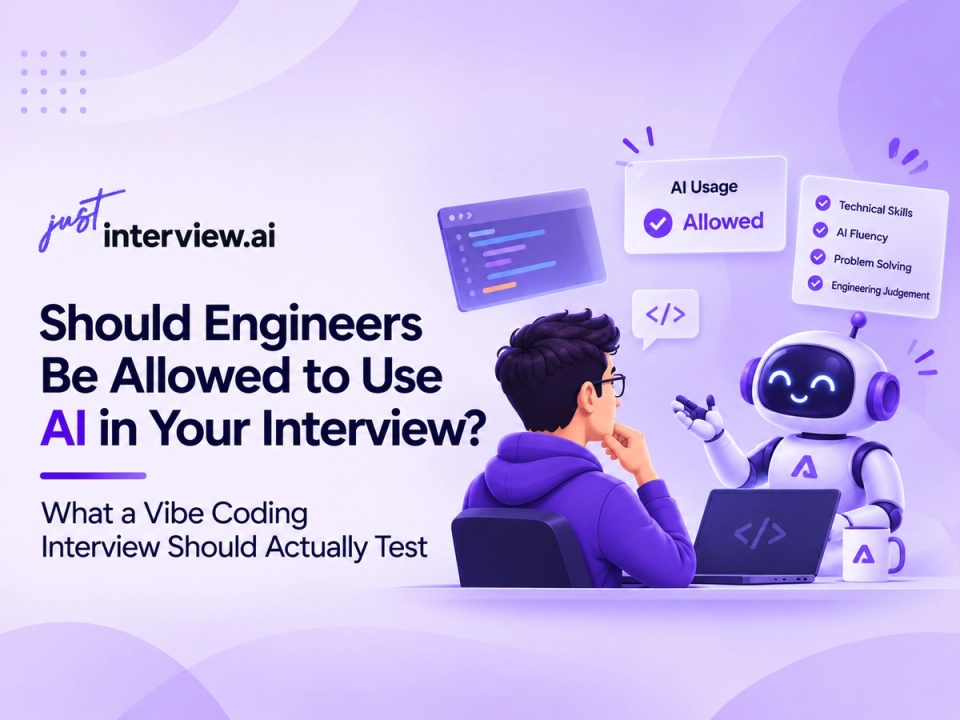
Here's a question worth asking before your next engineering interview: if two candidates solve the same coding problem, and one uses AI while the other doesn't, who performed better?
It's tempting to favour the person who wrote every line themselves. It feels like a cleaner demonstration of technical ability.
But think about how engineering actually works today. Developers use AI to explore unfamiliar code, generate test cases, debug errors, compare approaches and get through repetitive work. Knowing when to use these tools, what to ask them and when not to trust their answers is becoming part of the job.
So the better question is whether the candidate understood what they were doing with it. That changes what an engineering interview should test, and what your interview platform needs to evaluate.
What a vibe coding interview should test
A coding problem can tell you whether someone reached the expected output. It doesn't always explain how they got there.
Did they understand the problem? Could they spot an inefficient solution? Did they notice that the AI-generated code had a security issue? Could they explain why they chose one approach over another?
These are the details a vibe coding interview should bring out. Leave room for candidates to explain their thinking, challenge assumptions and talk through the decisions behind their work.
For example, instead of asking only "Write a function that sorts a list of numbers", try:
- How would you approach this if the input contained millions of records?
- If an AI tool suggested a solution, how would you check whether it was correct?
- What would make you reject an AI-generated solution, even if it passed the initial tests?
- Tell me about a time an AI coding assistant gave you an answer that looked right but wasn't.
- How would you explain the trade-offs between two possible solutions to another engineer?
There isn't always one perfect answer. What matters is the reasoning behind the response.
What to look for in an AI technical interview platform
Not every interview platform is built to evaluate modern engineering skills. Some focus on coding scores; others support technical conversations, practical tasks and structured evaluation.
Before choosing one, check whether it helps you understand three things.
1. Technical understanding
Can the candidate explain their code, identify errors, discuss edge cases and make improvements? A working solution is useful, but understanding why it works matters just as much.
2. AI fluency
Can the candidate use AI as a tool rather than blindly accept its output? Look for ways to see how they verify suggestions, catch hallucinations and make informed decisions about AI-generated code.
3. Engineering judgement
Can they think beyond the immediate problem? Good engineers weigh maintainability, performance, security and the trade-offs between approaches.
A platform should give you evidence of these abilities, not just another score to sort candidates by. In a JustInterview.ai vibe coding interview, candidates work with an AI assistant during the task, so reviewers can see how they prompt it, what they accept, and what they catch and fix.
The questions you ask matter as much as the platform
A platform can have impressive features and still produce unhelpful evaluations if the interview itself isn't designed well.
For engineering roles, make room for open-ended questions, practical problem-solving and follow-up conversations. Give candidates a chance to explain decisions rather than rewarding only rehearsed answers.
Also, be clear about whether AI tools are allowed during an assessment. If AI fluency is part of the role, evaluate how candidates use it instead of treating every instance of AI assistance as cheating.
Using AI more doesn't make someone a stronger engineer
AI isn't going to make every developer better. And using an AI tool doesn't automatically make someone technically strong.
But rejecting candidates simply because they know how to use these tools would miss an important part of how engineering work is changing.
When you evaluate interview platforms, look beyond coding scores. Look for structured technical interviews, practical assessments, meaningful follow-up questions and evaluations that show how candidates approach real problems.
You're not hiring someone to write code in an empty editor. You're hiring someone to solve engineering problems, make decisions and build things that work. Your interview should find out whether they can do that, with AI or without it.
Frequently asked questions
Should candidates be allowed to use AI during coding interviews?
It depends on the role and what the assessment is meant to measure. If developers will work with AI tools on the job, allowing them can show how well candidates prompt, verify and improve AI-generated code. Make the rules clear before the interview.
How can recruiters evaluate AI fluency in engineering candidates?
Ask candidates how they use AI coding assistants, how they verify generated code, what they do when a suggestion is wrong and how they decide whether to trust a solution.
Can an AI technical interview replace a human technical round?
It can handle early-stage technical screening and reduce repetitive evaluation work. Experienced engineers are still needed for deeper technical discussions and final hiring decisions.
Are coding scores enough to evaluate engineering candidates?
Not always. Coding scores show whether a candidate solved a particular problem, but may miss reasoning, code quality, debugging ability and engineering judgement. Combining coding tasks with technical conversation gives a fuller picture.
Key takeaways
- Coding scores alone may not reveal how well candidates understand their solutions.
- A vibe coding interview should test technical reasoning, debugging, AI fluency and engineering judgement.
- Interview platforms should support open-ended questions, practical tasks and meaningful follow-ups.
- Using AI isn't automatically a sign of strong engineering ability, but knowing how to use it thoughtfully is valuable.
Based on JIA internal platform data across 5,000+ candidates.
Get started
Don't just find someone who can code. Find someone who knows what to build.
Give candidates room to show their technical skills, problem-solving and AI fluency. JustInterview.ai's vibe coding interviews let candidates build with an AI assistant while you see how they prompt, check and fix its output.